Build the signed matching matrix
Encode the even square board and its local domino constraints in a determinant-compatible matrix.
THE IDEA, MADE VISIBLE
Require or forbid one diagonal-step domino and factor the resulting exact tiling count.
An even square can be tiled by dominoes. Requiring one location restricts the set of tilings; forbidding it selects the complementary set.
Requiring this location leaves 6 tilings. The exact factorization is 2^1 × 3. The board picture identifies the location, not every allowed tiling.
ν₂(N) = largest e for which 2ᵉ divides N, N > 0
Change the selected step and compare required with forbidden. Their counts add back to the unconstrained total.
What this experiment represents. Exact small-board, single-location enumeration. This does not reproduce every required, forbidden or mixed step-diagonal constraint in MATH-2026-15, or its separate unclaimed odd-square refinement.
Required, forbidden, and mixed constraints on even square boards
Analyzes the exact power of two in matching counts under required, forbidden, or mixed step-diagonal constraints. A binary inverse-kernel calculation links local constraints to principal-minor valuations.
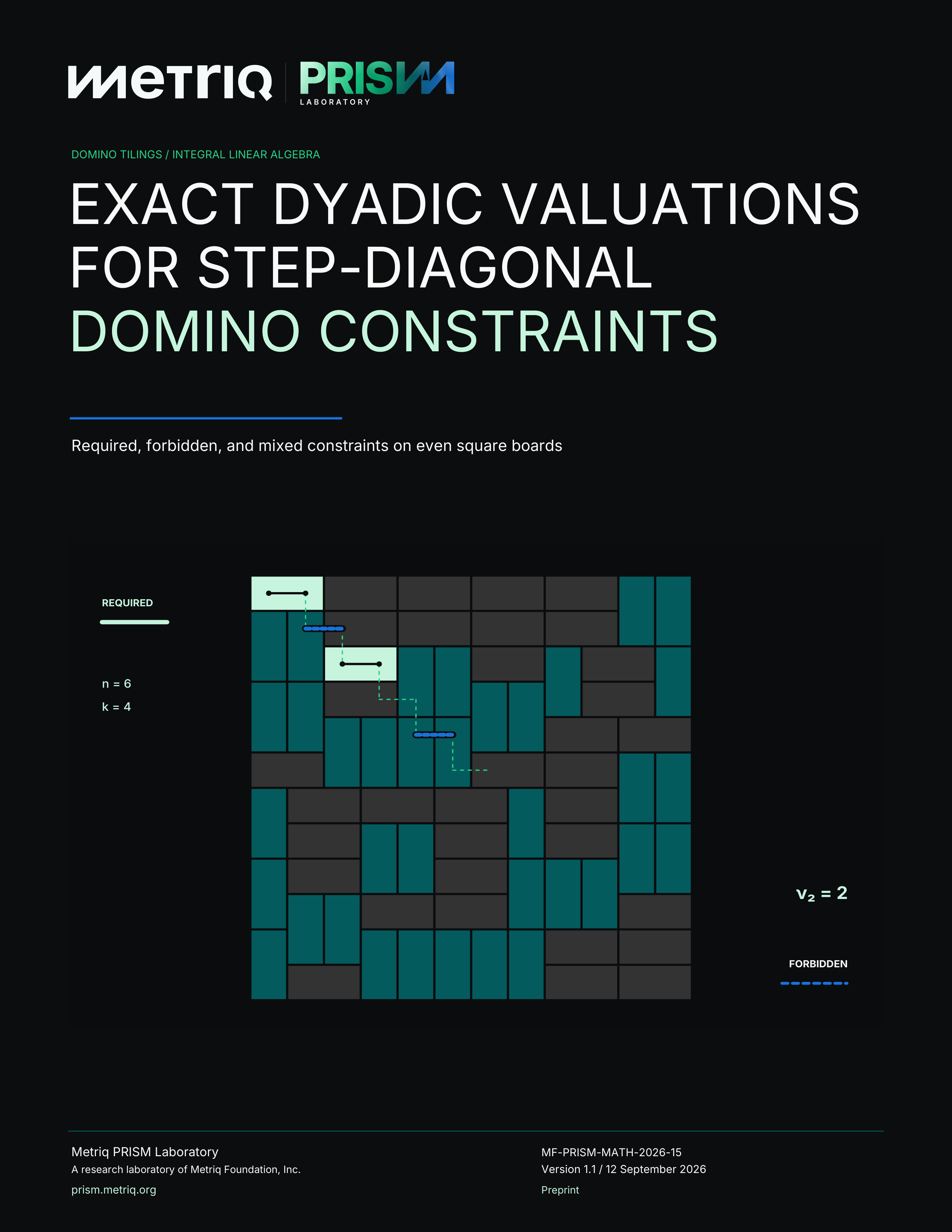
Rather than only counting constrained domino tilings, the paper determines the exact power of two dividing those counts for required, forbidden, and mixed step-diagonal constraints on even square boards.
Two tiling counts may be different but share the same hidden arithmetic structure. The dyadic valuation records exactly how many factors of two divide a count.
The paper studies local constraints along a step diagonal. It reduces the matching problem to an inverse-kernel calculation over characteristic two, then reads the valuation from principal minors and combines cases through inclusion–exclusion.
The paper’s technical details matter, but the basic route can be understood in three moves.
Encode the even square board and its local domino constraints in a determinant-compatible matrix.
Find the kernel basis modulo two and lift the inverse information far enough to control exact valuations.
Use principal minors for required or forbidden positions and inclusion–exclusion for mixed constraints.
The exact two-adic valuation is proposed for the stated required, forbidden, and mixed step-diagonal cases.
The calculation links local domino constraints to inverse residues and principal-minor valuations.
The theorem is explicitly confined to even square boards; a separate odd-square refinement is not imported.
Candidate exact-valuation theorem; the separate odd-square refinement is not claimed.
This manuscript presents a candidate resolution. Publication is not verification: independent specialist review remains necessary before the result should be treated as established.
The unproved odd-square refinement is outside the claim.
The formulas apply to the specified step-diagonal constraint family, not arbitrary deleted or forced domino patterns.
Signs, the boundary basis vector, and the lifting argument require specialist verification.
Exact valuations expose arithmetic structure that ordinary enumeration misses and distinguish the proved even-square theorem from an unproved odd-square refinement.
These are the terms needed to understand the claim. The full paper uses them more precisely.
The exponent of the highest power of two dividing an integer.
A determinant formed by selecting the same index set of rows and columns.
A counting method that corrects overlap by alternating additions and subtractions.
Arithmetic in which 1 + 1 = 0, useful for tracking parity.
The strongest review is not a general reaction. It tests the steps most capable of changing the conclusion.
This page is a reading guide, not a substitute for the manuscript. The public record links the explanation to the paper, source package, review materials, and persistent identifier.