Register before switching
Admit only signed profiles that are already in the local registry and bind each activation to a specific profile hash.
THE IDEA, MADE VISIBLE
Follow a profile from registration to activation, with a crash inserted at a precisely defined point.
The teaching profile is scheduled for slot 5 and must be durably registered before then. A desired change is not already an active configuration.
At slot 5, the active profile is NEW. Durable registration preserves the scheduled boundary across recovery.
active(slot) = registered && slot ≥ 5 ? NEW : OLD
Compare crashes before and after durable registration at slot 5. Only the persisted transition activates after recovery.
What this experiment represents. Deterministic teaching state machine. No signing, persistence, network communication or production validator is implemented by this browser demonstration.
A v27-compatible reference implementation, validator-design analysis, and slot-bound activation
Implement signed profile confinement, slot-bound activation and crash-safe recovery in a research reference system. The corrected four-validator reserve design is compared with alternatives in a synthetic timing emulator.
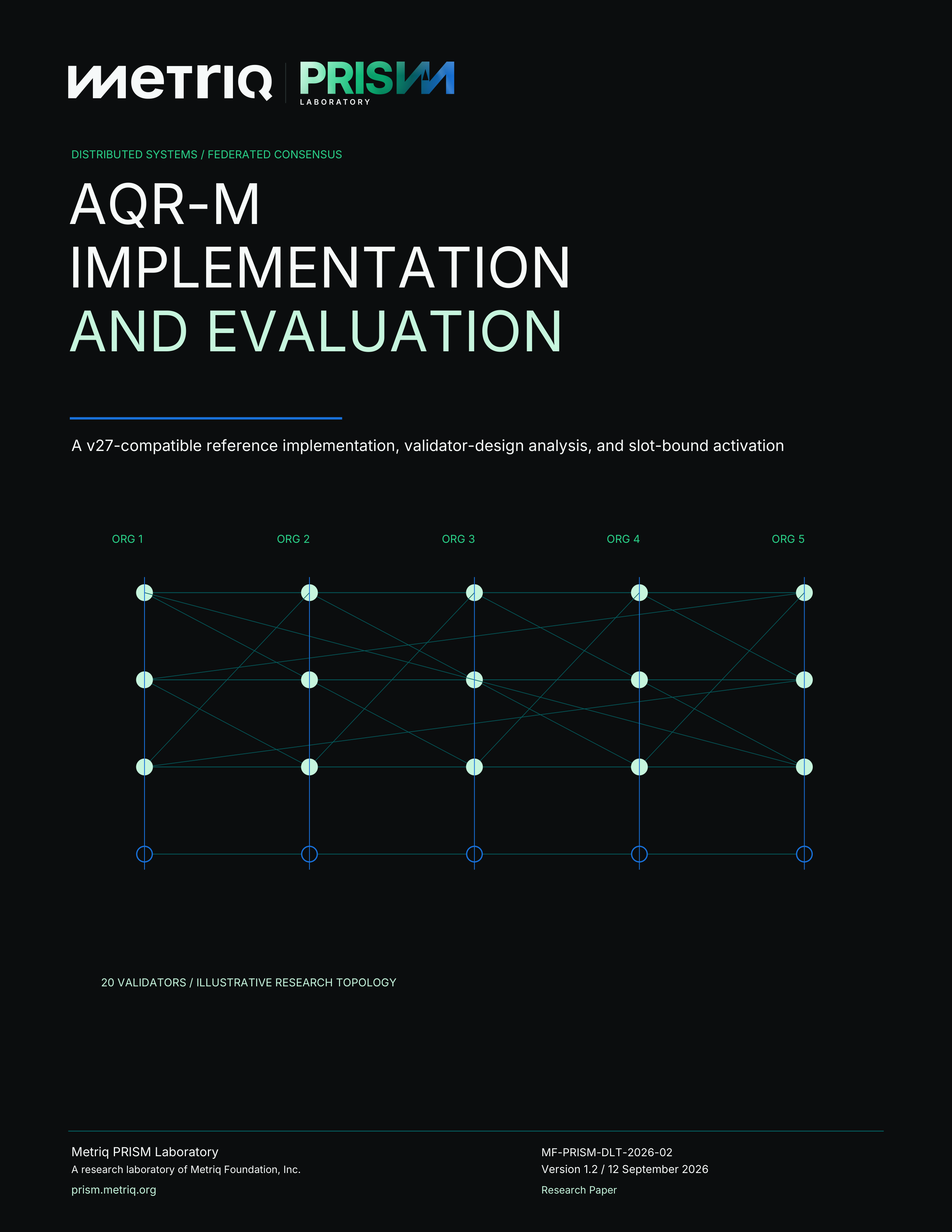
The paper converts Adaptive Quorum Reserve into reference code with signed allowed profiles, slot-bound switching, and crash recovery that replays the exact activation state.
A safe reconfiguration theory still needs implementation rules. A validator must know which profile is authorized, when a change becomes active, what hash it used in a given slot, and how to recover after a crash without inventing a different history.
AQR-M supplies those mechanics in a research reference system and compares the corrected four-validator reserve design with alternatives in a deterministic timing emulator.
The paper’s technical details matter, but the basic route can be understood in three moves.
Admit only signed profiles that are already in the local registry and bind each activation to a specific profile hash.
Permit one local quorum-set hash per slot so replay and peer interpretation are deterministic.
Journal activation decisions and reconstruct the same state after restart before processing new work.
The reference implementation turns profile confinement and activation into explicit state-machine rules.
Crash replay is part of the safety design rather than an operational afterthought.
The corrected four-validator reserve model is evaluated against alternatives in a synthetic timing environment.
Research reference implementation and synthetic timing evaluation, retaining the corrected four-validator reserve model of v1.1. No public-network deployment, compiled production patch, or production ledger-close benchmark is claimed.
This report develops a conditional method and evaluates it within the stated evidence. It does not establish production performance, operational safety, or calibrated real-world predictive skill beyond that evidence.
No compiled production Gravity patch or public-network deployment is claimed.
Synthetic timing results are not production ledger-close benchmarks.
Validator-level and organization-level Byzantine assumptions must not be conflated.
The work translates a safety idea into concrete activation, signing, replay, and recovery rules while keeping synthetic evaluation separate from production claims.
These are the terms needed to understand the claim. The full paper uses them more precisely.
A validator’s local rule describing which groups of peers are sufficient for agreement.
A discrete consensus instance or ledger position at which one configuration is active.
Restoring the same protocol state after an unexpected process stop.
An authorized configuration whose exact contents are cryptographically authenticated.
The strongest review is not a general reaction. It tests the steps most capable of changing the conclusion.
This page is a reading guide, not a substitute for the manuscript. The public record links the explanation to the paper, source package, review materials, and persistent identifier.