Define profile choices
List the quorum profiles each validator may select and the assumptions governing independent local choice.
THE IDEA, MADE VISIBLE
Lower a quorum threshold and watch global intersection disappear, even though every local choice looks plausible.
In this teaching network, every validator accepts any group of at least k of the same six validators. A quorum is a group that can satisfy those local rules.
The selectable-profile envelope admits 4-of-6. Its minimum pairwise overlap is 2; quorum intersection holds in this teaching network.
For uniform k-of-n: minimum overlap = max(0, 2k−n)
Keep the default at 4-of-6 and enable the 3-of-6 reserve. The minimum possible overlap falls to zero.
What this experiment represents. Exact uniform-threshold teaching network, not the full AQR topology or a production Metriq certificate. Intersection alone does not establish Byzantine protocol correctness.
Profile envelopes, reserve-collapse, and certified reconfiguration
Certify the envelope of every independently selectable local quorum profile before allowing adaptation. The paper studies reserve collapse and version transitions, with finite structural checks rather than a complete consensus implementation.
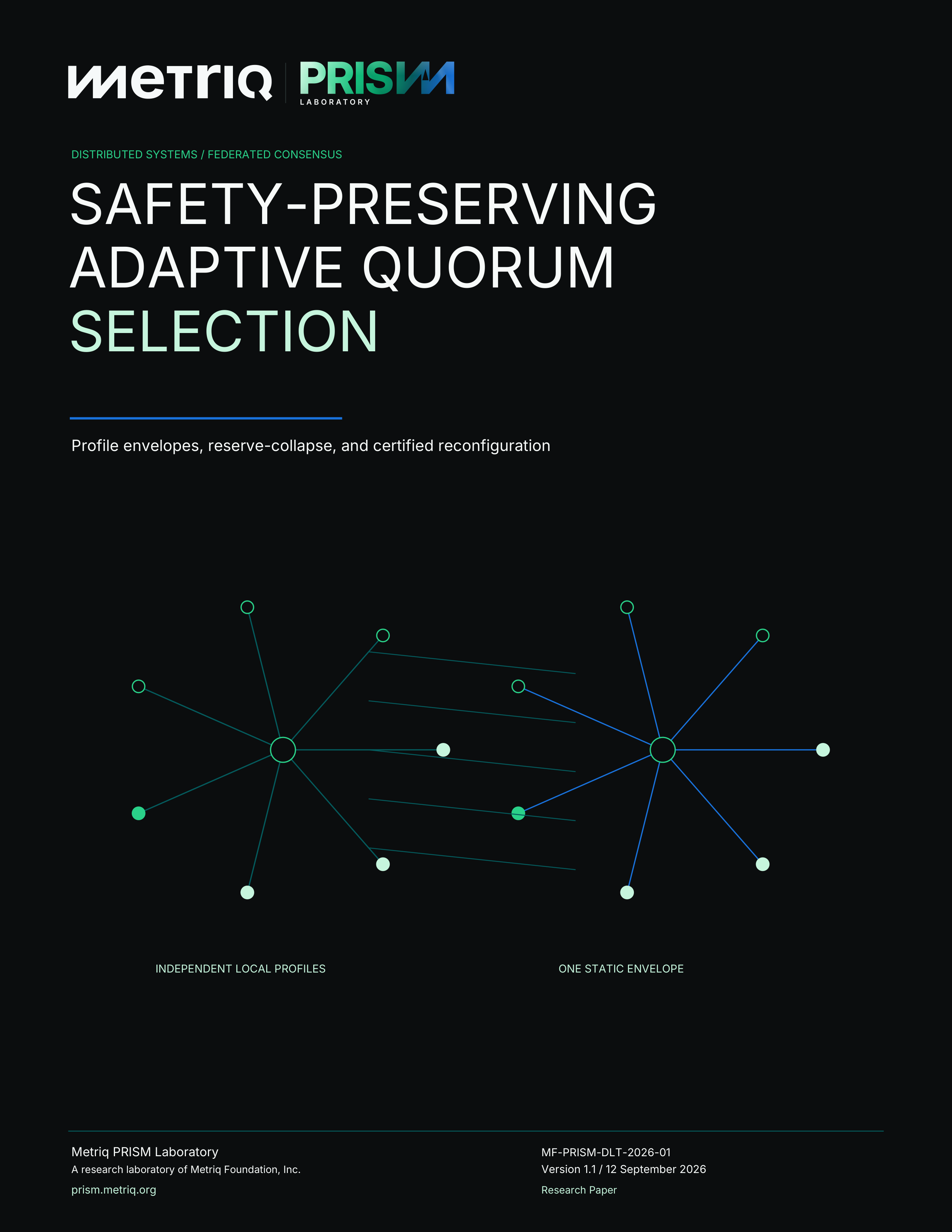
The paper requires the network to certify every combination of locally selectable quorum profiles before validators are allowed to adapt among them.
In federated consensus, each validator chooses which groups of other validators it trusts. If nodes change those choices independently, a collection of individually reasonable updates can destroy the network-wide property that any two quorums overlap.
The paper treats all permitted local choices as one envelope. Safety is certified over the entire envelope—including mixed versions during transition—before adaptation is enabled.
The paper’s technical details matter, but the basic route can be understood in three moves.
List the quorum profiles each validator may select and the assumptions governing independent local choice.
Compute the union of quorums that can arise across all allowed profile combinations.
Analyze reserve collapse and mixed-version states so reconfiguration does not rely on every validator switching simultaneously.
Safety is checked over the whole adaptive choice space, not one configuration at a time.
Reserve collapse exposes when nominal backup capacity disappears under combined choices.
Mixed-version transitions are treated as part of the safety problem.
Quorum-envelope theory with exact finite verification and illustrative synthetic evaluation. The results do not constitute a complete consensus proof or production network benchmark.
This report develops a conditional method and evaluates it within the stated evidence. It does not establish production performance, operational safety, or calibrated real-world predictive skill beyond that evidence.
Quorum intersection is necessary but not a complete proof of consensus correctness or liveness.
The topology and profile family are illustrative rather than a production-network benchmark.
Independent-choice and Byzantine-fault assumptions must match the deployment being certified.
Adaptive settings are only safe if every allowed combination remains structurally compatible. Certifying the whole choice envelope prevents local optimization from creating a global safety failure.
These are the terms needed to understand the claim. The full paper uses them more precisely.
A set of validators sufficient to support a consensus decision under the network’s trust rules.
The property that every two quorums share at least one validator.
The full set of network configurations reachable from allowed local profile choices.
Consensus in which participants define their own trust relationships rather than using one global membership rule.
The strongest review is not a general reaction. It tests the steps most capable of changing the conclusion.
This page is a reading guide, not a substitute for the manuscript. The public record links the explanation to the paper, source package, review materials, and persistent identifier.