Acquire with a manifest
Record source URLs, versions, retrieval times, checksums, and expected schemas for every environmental and biological input.
THE IDEA, MADE VISIBLE
Follow an environmental record through a strict data pipeline—and see where an unsupported answer must stop.
A reproducible pipeline keeps source version, spatial support, units and observation time with the values. This calendar is synthetic, not an acquired public dataset.
8 days are missing. The strict pipeline refuses to reconstruct DHW from incomplete support.
DHW = (1/7) Σ₈₄ Hᵢ · 1{Hᵢ ≥ 1°C}, only with complete daily support
Switch between strict and zero-filled modes. The second invents a result; it does not recover the missing observations.
What this experiment represents. Synthetic completeness check. No public bleaching records are acquired and no prediction is fitted. The zero-filled result is shown only to demonstrate the bias caused by an invalid policy.
A version-aware acquisition and exposure-audit pipeline for PRISM ReefWatch
Translate observation-aligned evaluation into a version-aware public-data acquisition and exposure-audit prototype. The offline tests preserve missingness, provenance and chronology rather than silently filling gaps.
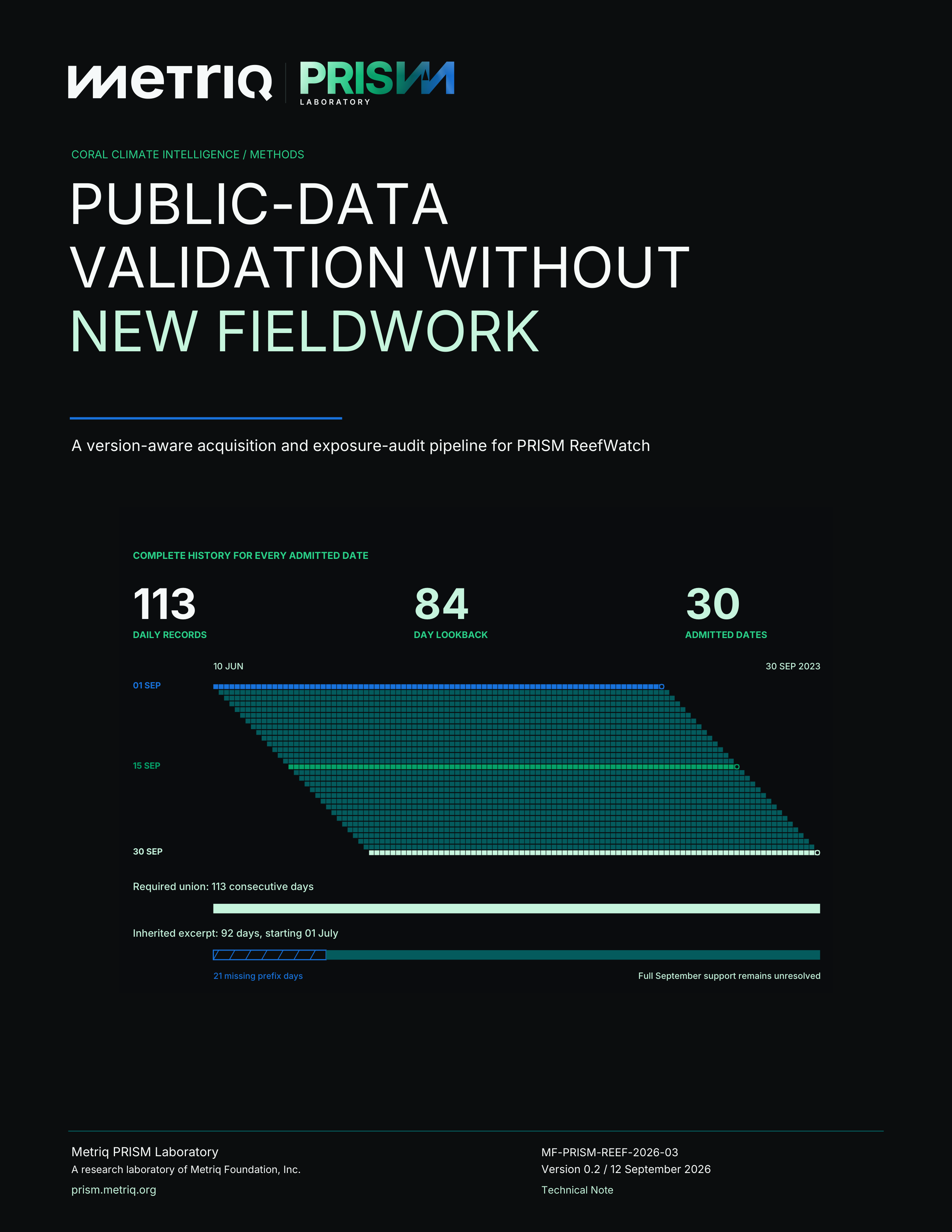
The note turns the validation design into a public-data pipeline that can run without fieldwork while refusing to erase missingness, source versions, or chronology.
A computer-only validation program is possible, but only if public records are treated as evidence with provenance—not as interchangeable spreadsheet rows.
The prototype records what was requested, which version arrived, how temperatures were assigned to reef observations, where coverage is missing, and whether acquisition was blocked. Missing outcome is kept distinct from measured zero.
The paper’s technical details matter, but the basic route can be understood in three moves.
Record source URLs, versions, retrieval times, checksums, and expected schemas for every environmental and biological input.
Map temperature histories to biological observations with explicit units, masks, spatial rules, and complete lookback support.
Preserve missing values, blocked downloads, and test-double boundaries in machine-readable validation reports.
The proposed validation workflow requires no new fieldwork.
Versioning and provenance are first-class parts of the result.
The offline-tested prototype distinguishes missing observations from observed zero bleaching.
Technical note and offline-tested public-data acquisition prototype. No real bleaching records were acquired or fitted, and no new fieldwork is required.
This technical note documents an acquisition and validation method. It is not a fitted biological model and does not claim new field observations.
No real bleaching records were acquired or fitted in this edition.
Public endpoints, schemas, and source versions may change and must be revalidated.
The note establishes data plumbing and auditability, not a biological forecasting result.
The design makes a serious validation program possible from a computer while treating missing data, source versions, spatial assignment, and chronology as first-class evidence.
These are the terms needed to understand the claim. The full paper uses them more precisely.
The documented origin, version, and processing history of a data item.
The state in which a value was not observed; it is not equivalent to zero.
The rule mapping an environmental measurement to a biological observation location.
A controlled substitute used to test software behavior without relying on a live external service.
The strongest review is not a general reaction. It tests the steps most capable of changing the conclusion.
This page is a reading guide, not a substitute for the manuscript. The public record links the explanation to the paper, source package, review materials, and persistent identifier.