Guide choices with a potential
Require local improvements to align approximately with a global scalar objective despite bounded telemetry error.
THE IDEA, MADE VISIBLE
A real advantage can be obscured by noisy telemetry. Test how a switching margin changes behavior.
Two configurations can both be structurally admissible while a controller oscillates between them. A safe choice set does not automatically create stable adaptive behavior.
This bounded-noise trace makes 1 switch and ends on B. A higher switching margin trades responsiveness for resistance to oscillation.
Switch only when measured gain over the current profile > margin.
Compare margin zero with margin 0.60. A quiet controller is not automatically an optimal one: too much hysteresis can leave it on the worse profile.
What this experiment represents. Synthetic single-controller trace with fixed true advantage and bounded deterministic measurement error. Not a simulation of complete federated consensus or proof of the multi-controller theorem.
Potential-guided selection, robust hysteresis, conflict-colored activation, and failover rendezvous
Separate structurally safe configurations from adaptive-controller convergence. The paper studies oscillation, robust switching margins, conflict-free parallel changes and recovery rendezvous under explicit assumptions.
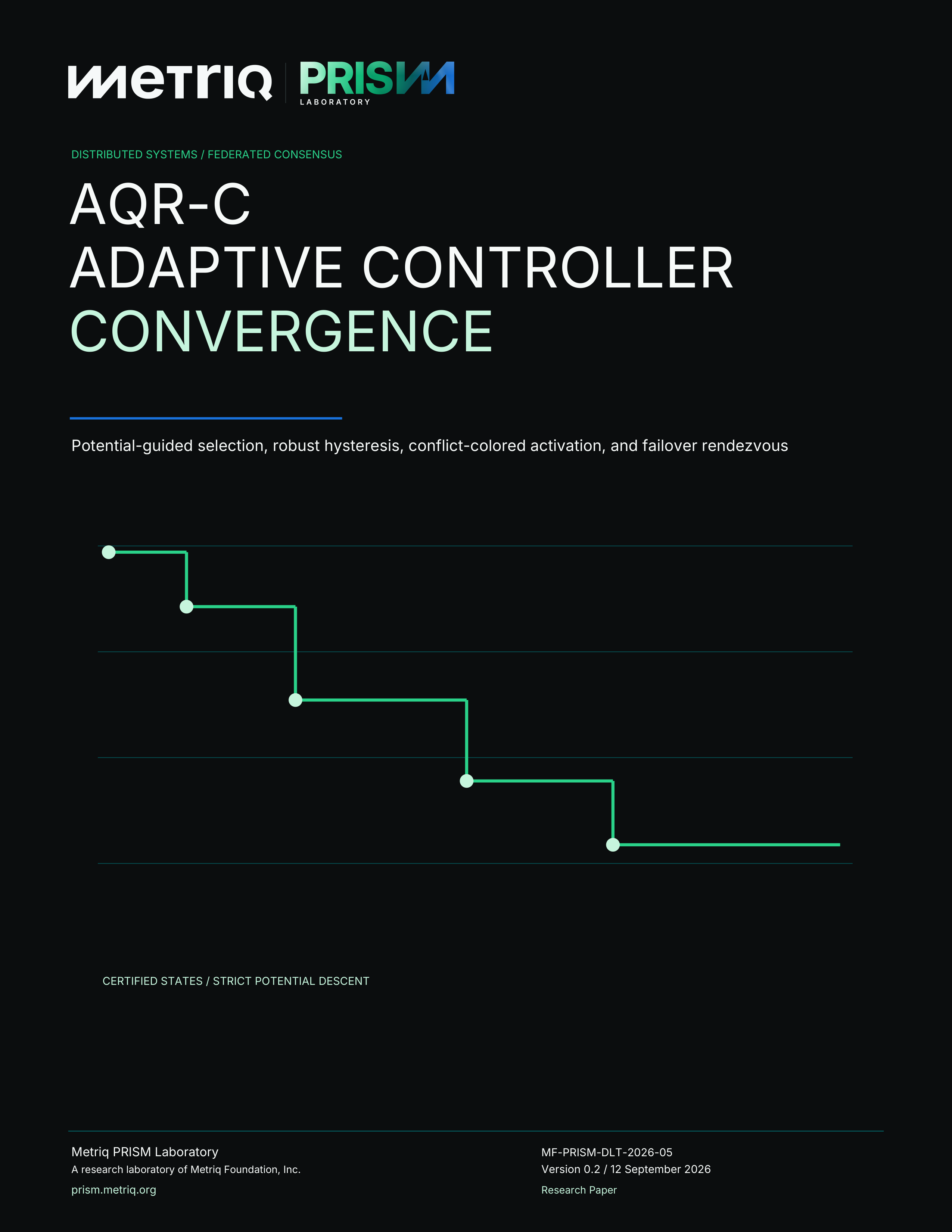
The paper separates configuration safety from controller stability and gives conditions under which independently adapting validators settle instead of oscillating.
Even if every selectable quorum configuration is safe, local controllers can still keep switching back and forth, react to noisy telemetry, or activate incompatible changes at the same time.
AQR-C introduces a near-potential objective, robust hysteresis, a conflict graph for parallel changes, and a shared failover rendezvous. Together these mechanisms aim to make distributed adaptation converge under explicit assumptions.
The paper’s technical details matter, but the basic route can be understood in three moves.
Require local improvements to align approximately with a global scalar objective despite bounded telemetry error.
Demand a sufficient improvement margin before switching so noise cannot trigger endless reversals.
Color a conservative conflict graph for parallel activation and use a common rendezvous state during failover.
Structural quorum safety and adaptive-controller convergence are distinct proof obligations.
Hysteresis and bounded-error margins prevent small telemetry fluctuations from causing thrashing.
Conflict-aware activation allows some changes in parallel while preserving the convergence argument.
Convergence conditions and synthetic controller experiments. Structural safety, controller convergence, and complete consensus correctness remain separate obligations.
This report develops a conditional method and evaluates it within the stated evidence. It does not establish production performance, operational safety, or calibrated real-world predictive skill beyond that evidence.
Controller convergence does not by itself prove consensus safety or liveness.
The argument assumes the environment eventually stabilizes within stated bounds.
Nodes must identify shared recovery scenarios consistently for the rendezvous mechanism to work.
A set of safe configurations is not enough: controllers can still thrash between them. The paper isolates the additional assumptions needed for stable adaptation.
These are the terms needed to understand the claim. The full paper uses them more precisely.
Reaching a stable configuration rather than switching indefinitely.
A switching margin that prevents immediate reversal after small input changes.
A scalar quantity used to show that each permitted update makes global progress.
A graph marking which changes cannot safely activate at the same time.
The strongest review is not a general reaction. It tests the steps most capable of changing the conclusion.
This page is a reading guide, not a substitute for the manuscript. The public record links the explanation to the paper, source package, review materials, and persistent identifier.