Freeze formal trust
Treat the validator’s quorum set as immutable during overlay optimization.
THE IDEA, MADE VISIBLE
Add transport links while the formal validator trust predicate stays exactly the same.
For each comparison at a fixed message threshold, the accepted validator set and threshold remain unchanged. Transport changes do not rewrite the trust predicate.
With 1 additional links, the 4th remote message arrives after 70 synthetic milliseconds. Adding a link did not change the 4-of-5 trust predicate.
Threshold arrival = kth smallest trusted-message arrival time.
Keep the message threshold at 4 and add links. Delivery time changes, but the trust predicate displayed below does not.
What this experiment represents. Deterministic weighted-graph routing example. Delay numbers are invented teaching inputs, not network measurements or a production ledger-close benchmark. The threshold control starts a separate fixed-trust comparison.
Trust-plane invariance, timely-quorum covers, and fault-domain-constrained peer selection
Optimize how quorum messages reach a validator while keeping the formal trust predicate fixed. The study uses timely-quorum coverage, diversity constraints and bounded transport changes in a synthetic dissemination emulator.
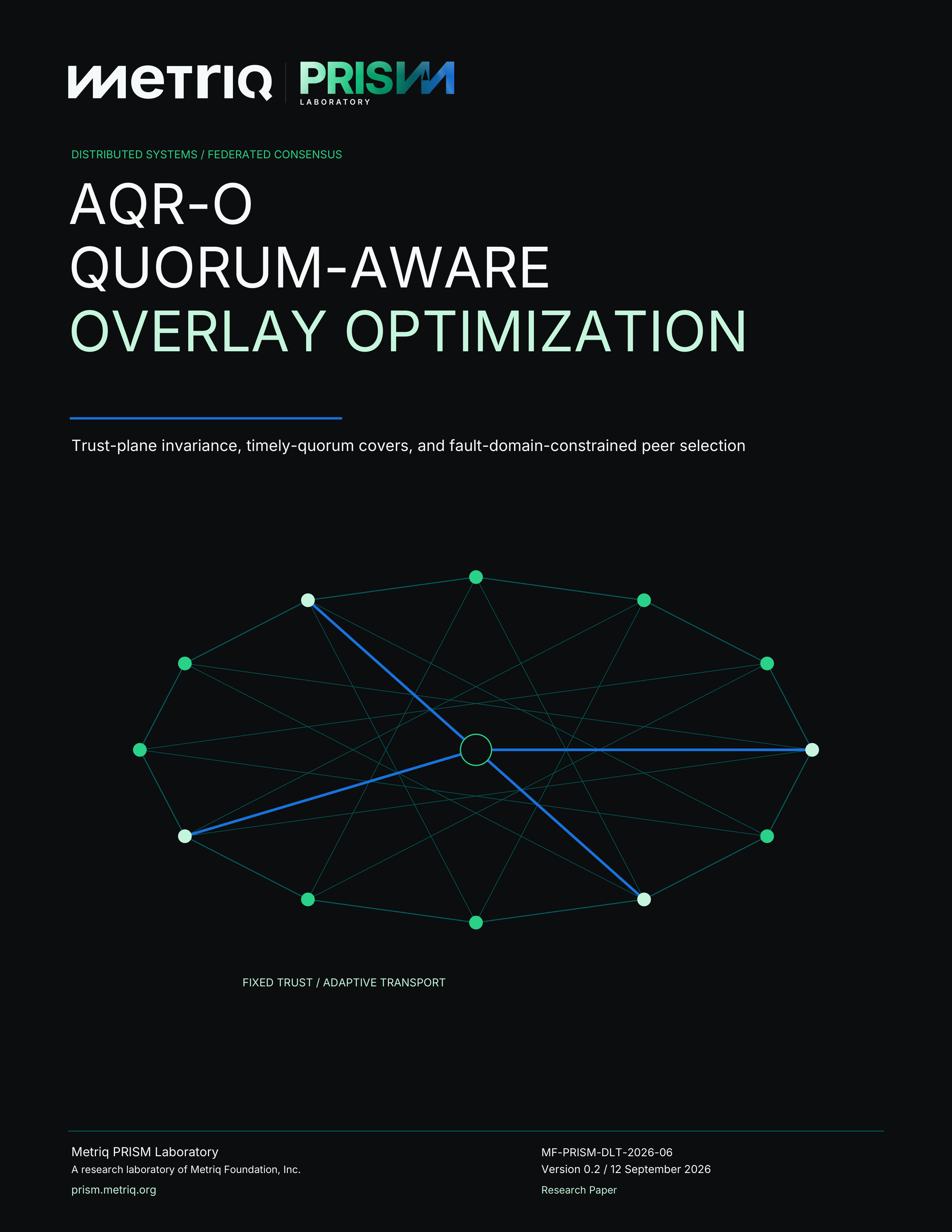
The paper optimizes which peers carry consensus messages while freezing the validator’s formal trust rule, separating transport improvements from quorum-set mutation.
A validator may trust the right nodes yet hear from them too slowly because its network connections are poorly chosen. Changing the quorum set to fix transport can silently change the safety assumptions.
AQR-O holds the trust plane fixed and optimizes only the overlay: which peers are connected, how messages are relayed, and whether a timely set of messages can satisfy the unchanged quorum formula.
The paper’s technical details matter, but the basic route can be understood in three moves.
Treat the validator’s quorum set as immutable during overlay optimization.
Use arrival-time abstractions to determine which connected peers can deliver enough quorum support before a deadline.
Optimize timely-quorum coverage subject to peer limits, churn bounds, and fault-domain diversity.
Transport and trust are treated as separate control planes.
Peer selection is optimized for timely quorum coverage without rewriting the quorum predicate.
Diversity constraints reduce the chance that one transport or infrastructure failure defeats the overlay.
Fixed-trust overlay methods and a deterministic dissemination emulator. No compiled hot-overlay Gravity patch, complete SCP simulation, or production performance claim is included.
This report develops a conditional method and evaluates it within the stated evidence. It does not establish production performance, operational safety, or calibrated real-world predictive skill beyond that evidence.
No production hot-overlay Gravity patch is included.
The emulator is not a complete SCP or adversarial network simulation.
Fixed formal trust does not eliminate eclipse or availability risk in the transport layer.
Separating the transport plane from the trust plane creates room to improve timeliness while avoiding silent quorum-set changes that would alter safety assumptions.
These are the terms needed to understand the claim. The full paper uses them more precisely.
The chosen peer-to-peer connections used to move protocol messages.
The formal quorum or authorization rules defining whose agreement counts.
The network paths and peers used to deliver messages.
Enough quorum-supporting messages arriving before a chosen deadline.
The strongest review is not a general reaction. It tests the steps most capable of changing the conclusion.
This page is a reading guide, not a substitute for the manuscript. The public record links the explanation to the paper, source package, review materials, and persistent identifier.