Model one latent path
Represent the evolving fire regime with one persistent state process rather than unrelated horizon-specific predictors.
THE IDEA, MADE VISIBLE
A coherent first-event forecast grows along one path. Missing outcomes must remain visible in evaluation.
This toy process has a constant probability h of a first event during each hour, conditional on no earlier event. The same process determines every horizon.
One synthetic path gives 31.9% by 3 hours and 78.4% by 12. Separately, 4 unresolved labels allow a batch event fraction of 25–58%.
P(first event by t) = 1 − (1−h)ᵗ
Increase unresolved outcomes. The admissible event fraction widens, while the coherent model curve remains unchanged.
What this experiment represents. Constant-hazard synthetic first-event process and a separate constructed label-completeness example. The label fraction is not a calibration test of this hazard curve. No operational probabilities are estimated.
Coherent multi-horizon risk, unresolved outcomes, and incident-balanced selective validation
Develop coherent risk statements across several forecast horizons while retaining uncertainty about the latent state and unresolved outcomes. The evidence remains conditional and synthetic, not a calibrated operational wildfire forecast.
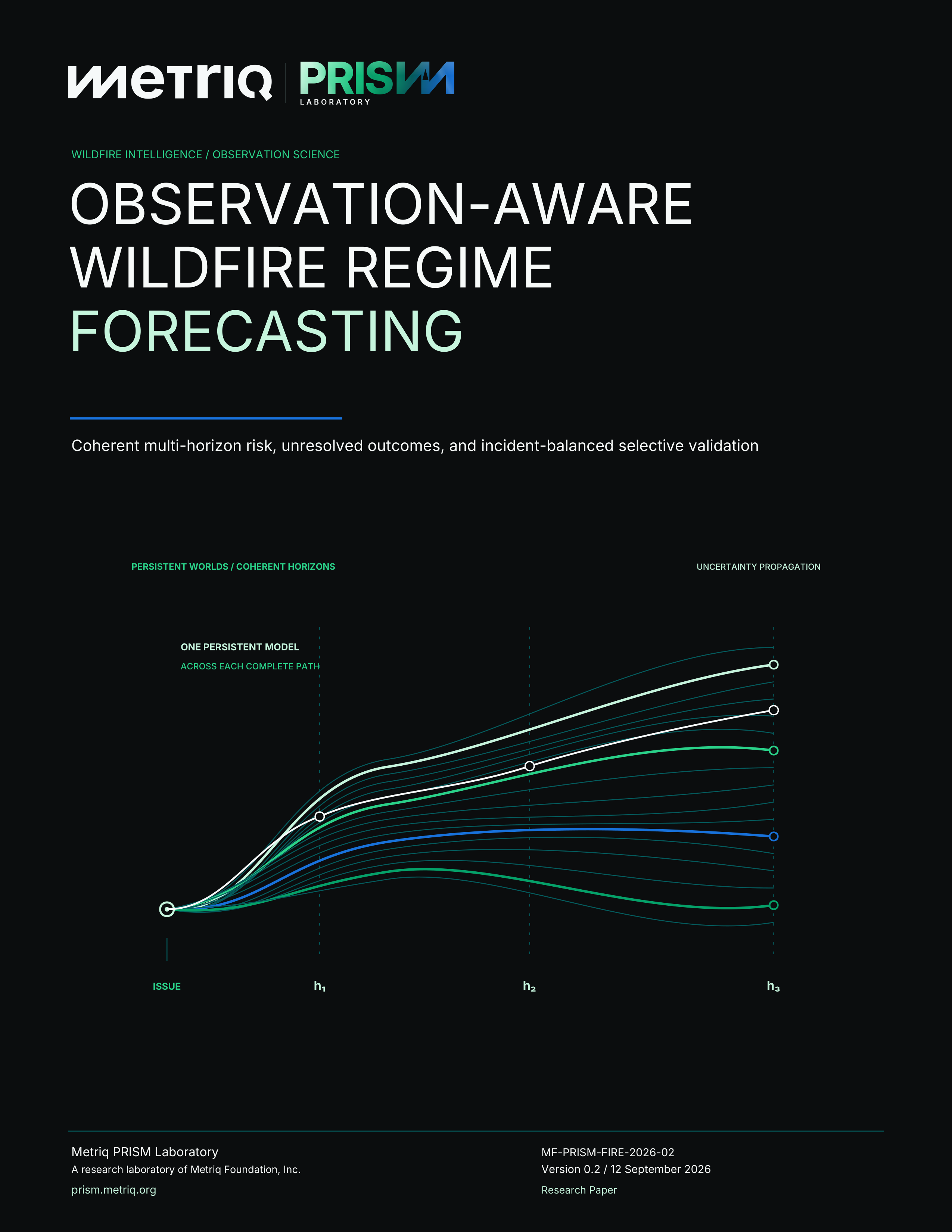
The paper makes short-, medium-, and longer-horizon wildfire risk statements come from one persistent model while retaining unresolved outcomes instead of quietly deleting them.
A forecasting system can look precise while contradicting itself: the 6-hour risk may be high, the 12-hour risk low, and the 24-hour risk high again because separate models were fit independently.
This paper proposes one latent regime path that generates all horizons coherently. It also treats unresolved incidents as unresolved, supports selective abstention, and balances evaluation by incident so large or well-observed fires do not dominate the score.
The paper’s technical details matter, but the basic route can be understood in three moves.
Represent the evolving fire regime with one persistent state process rather than unrelated horizon-specific predictors.
Compute multi-horizon risk from the same path distribution so probabilities obey a common internal model.
Retain unresolved labels, report selective coverage, and aggregate results in an incident-balanced way.
Multi-horizon probabilities are constrained to be mutually coherent under one model.
Unresolved outcomes are retained rather than silently recoded or discarded.
Selective forecasting is evaluated together with coverage, so abstention cannot masquerade as accuracy.
Conditional forecasting and selective-evaluation methods with synthetic evidence. No operational forecast or calibrated real-fire probabilities are established. Research only; not an official emergency warning.
This report develops a conditional method and evaluates it within the stated evidence. It does not establish production performance, operational safety, or calibrated real-world predictive skill beyond that evidence.
The probabilities are not calibrated for operational real-fire use.
A coherent model can still be wrong if its regime assumptions are misspecified.
This research is not an emergency warning system.
Operational-looking probabilities are dangerous when horizons conflict or labels are incomplete. The framework forces one persistent path model and evaluation that does not silently discard unresolved incidents.
These are the terms needed to understand the claim. The full paper uses them more precisely.
The future time interval for which a prediction is issued.
An unobserved condition inferred indirectly from available measurements.
A system that may abstain when its evidence is insufficient.
Agreement between stated probabilities and observed frequencies over comparable cases.
The strongest review is not a general reaction. It tests the steps most capable of changing the conclusion.
This page is a reading guide, not a substitute for the manuscript. The public record links the explanation to the paper, source package, review materials, and persistent identifier.