Pair terms and tails
Group the disturbed binary terms so the remaining tail and the visible gaps can be described exactly.
THE IDEA, MADE VISIBLE
Perturb the binary construction, refine it, and watch geometry approach a shape without settling its topology.
At t = 0, each pair contributes a base-four digit 0, 1, 2 or 3. The infinite achievement set is the full unit interval.
At t = 1, the depth-4 floating-point outer display has 70 components. Its shaded length is not the exact measure of the infinite set.
Kₜ = {0, 1/(4+t), 1/2, 1/2+1/(4+t)} + ¼Kₜ/₄
Set t to zero, then to one. Increase the prefix depth and notice how a coarse visual resemblance can hide a different structure.
What this experiment represents. Floating-point outer-approximation display, not the paper’s exact rational interval certificates. The positive-measure claim at t = 1 does not settle the Cantor-set-versus-Cantorval question.
Positive measure, infinite gaps, and exact scale recursion
Establishes positive measure and quantitative bounds for a disturbed binary achievement set, together with an exact renormalization identity. It isolates the remaining interior question rather than settling the complete topological classification.
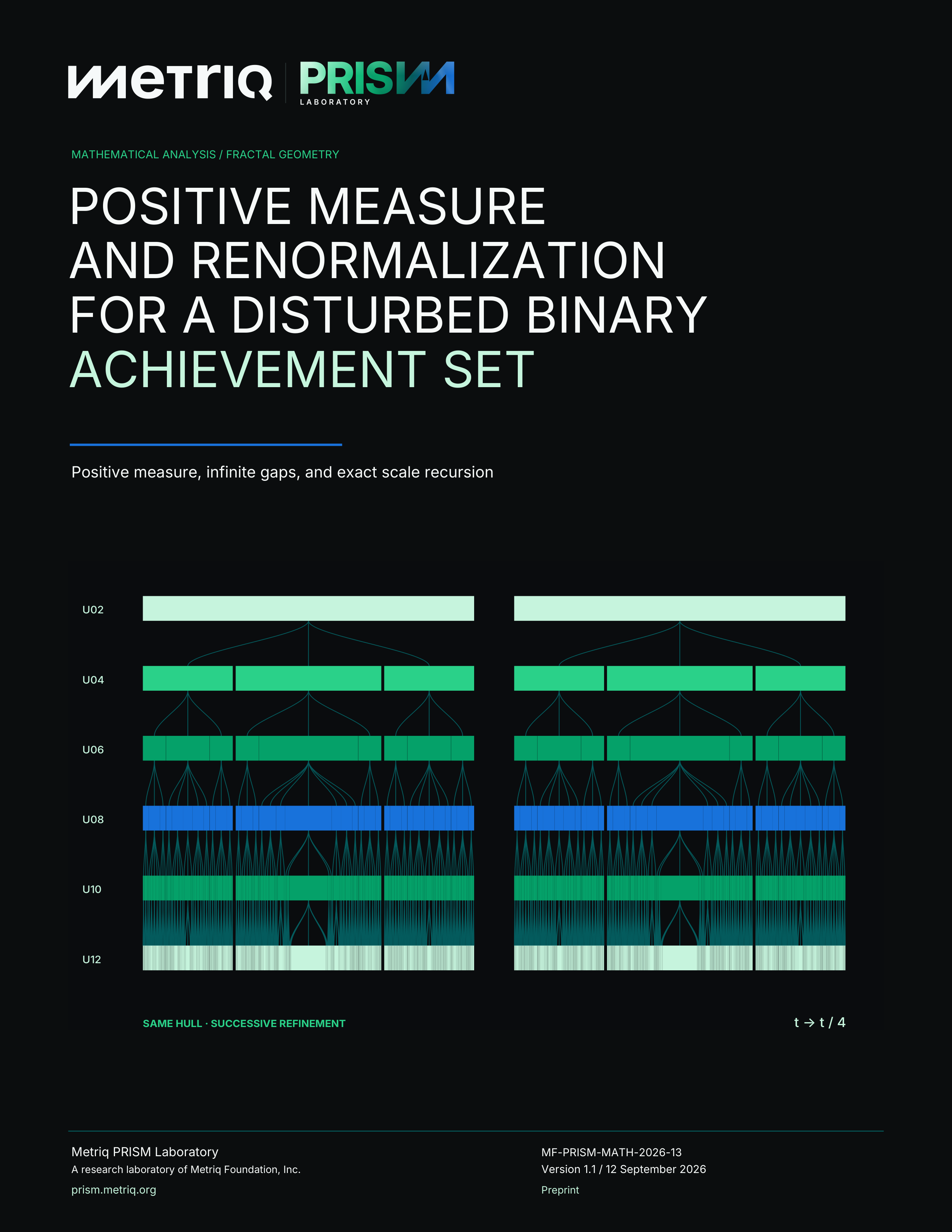
The paper proves that a disturbed binary achievement set has positive measure and an exact self-similar recursion, while leaving the decisive question—whether it contains intervals—open.
An achievement set contains every possible subsum of an infinite series. Small changes to a binary-style series can produce a dust-like Cantor set, an interval-rich Cantorval, or something whose classification is difficult.
This paper does not force a premature classification. It establishes measurable size, identifies infinitely many gaps, and derives a renormalization identity that shows how the set repeats across scales. Those facts narrow the remaining interior problem.
The paper’s technical details matter, but the basic route can be understood in three moves.
Group the disturbed binary terms so the remaining tail and the visible gaps can be described exactly.
Use nested outer approximations to prove positive measure and obtain quantitative upper and lower bounds.
Show that pieces of the set are affine copies of later pieces, producing an exact renormalization family.
The achievement set has positive Lebesgue measure.
It still has infinitely many gaps, so positive measure alone does not settle its topology.
An exact renormalization identity isolates the remaining question of whether the set has nonempty interior.
Partial progress: positive measure and renormalization do not settle the remaining Cantor-set-versus-Cantorval classification.
This manuscript develops a method and finite evidence, but it does not resolve the full open problem. The unresolved boundary is part of the published result.
Positive measure does not imply that the set contains an interval.
The paper does not classify the set as a Cantor set or a Cantorval.
Possible overlap overcounting in the measure bounds is a central point for review.
The results narrow the remaining classification problem and supply exact structure that future work can use without pretending the Cantor-set-versus-Cantorval question is finished.
These are the terms needed to understand the claim. The full paper uses them more precisely.
The set of all subsums obtained by choosing any subset of a convergent series.
The standard notion of length or size for subsets of the real line.
A compact set with both interval-like interior and fractal boundary behavior.
An exact rule showing how a structure reappears after rescaling and translation.
The strongest review is not a general reaction. It tests the steps most capable of changing the conclusion.
This page is a reading guide, not a substitute for the manuscript. The public record links the explanation to the paper, source package, review materials, and persistent identifier.