Expose the scaling defect
Multiply a valid-looking digit block by a nonunit factor in a composite base and track the residue classes that become unreachable.
THE IDEA, MADE VISIBLE
A complete set of residues need not stay complete when every number is multiplied by the same factor.
The original digits 0 through b−1 represent every residue class modulo b exactly once.
Multiplication by 2 modulo 6 reaches 3 of 6 residues. A common factor causes collisions.
Number of reached residues = b / gcd(b,c)
Set base 6 and scale 2: six residues collapse to three. Scale 5 preserves all six.
What this experiment represents. Exact modular-arithmetic illustration of scaling. It does not reproduce the manuscript’s full base-four classification or certify all multigeometric hypotheses.
Composite-base counterexamples and a complete base-four classification
Constructs scaling counterexamples to residue completeness in every composite base and classifies the four-digit base-four case. Primitive normalization separates the literal obstruction from a stronger corrected problem.
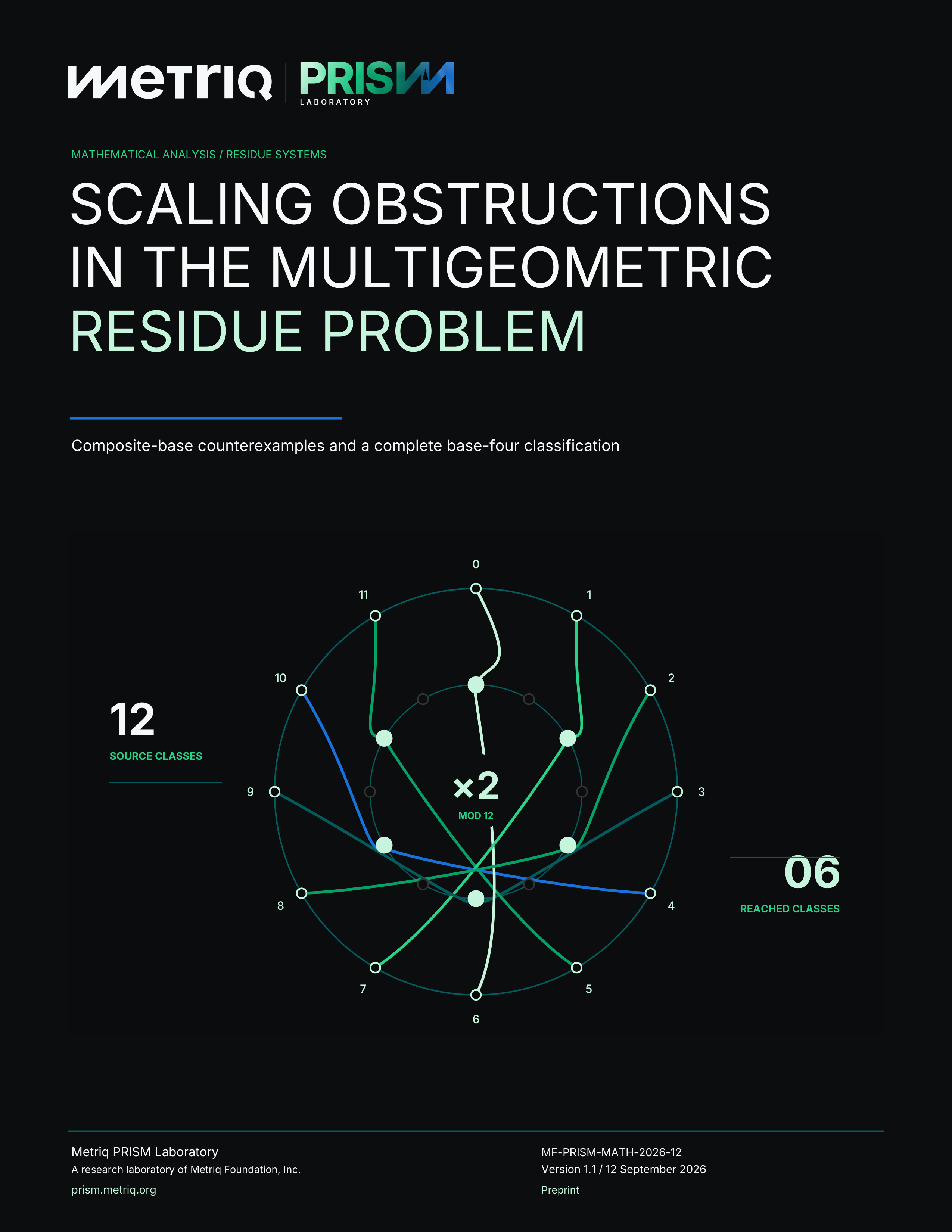
The paper shows that the literal composite-base residue claim is defeated by a simple scaling obstruction, then separates that defect from the more meaningful primitively normalized problem.
A residue-completeness statement asks whether subset sums hit all required congruence classes. In a composite base, multiplying every digit by a common factor can make the construction miss entire residue classes while still satisfying the literal printed hypotheses.
The paper uses that observation to build counterexamples in every composite base. It then removes the artificial scaling freedom through primitive normalization and gives a complete classification for the four-digit base-four case.
The paper’s technical details matter, but the basic route can be understood in three moves.
Multiply a valid-looking digit block by a nonunit factor in a composite base and track the residue classes that become unreachable.
Enumerate the four-digit subset-sum block structure and separate primitive from imprimitive cases.
Apply a two-adic criterion to state the exact normalized base-four conclusion.
The literal composite-base statement admits a family of scaling counterexamples.
Primitive normalization identifies the stronger version of the question that avoids the trivial obstruction.
The four-digit base-four normalized case receives a complete classification.
Candidate counterexamples to the literal composite-base statement; primitive base-four normalization is treated separately.
This manuscript presents a candidate resolution. Publication is not verification: independent specialist review remains necessary before the result should be treated as established.
The paper may be answering the literal wording rather than the source author’s intended normalized question.
The complete classification is for the stated base-four block, not every primitive multigeometric system.
Other corrected formulations remain open unless explicitly covered by the theorem.
It separates a literal statement defeated by scaling from the stronger normalized problem that carries the real mathematical content.
These are the terms needed to understand the claim. The full paper uses them more precisely.
A set of integers that are equal modulo a chosen base or modulus.
A base with a nontrivial factor, such as 4, 6, or 10.
Removing a common factor so the digit data are not an artificial scaling of a smaller system.
Concerned with divisibility by powers of two.
The strongest review is not a general reaction. It tests the steps most capable of changing the conclusion.
This page is a reading guide, not a substitute for the manuscript. The public record links the explanation to the paper, source package, review materials, and persistent identifier.