Identify the feasible cone
Derive the linear inequalities that constrain independence-polynomial coefficients for the W_p class.
THE IDEA, MADE VISIBLE
Count independent choices in a simple clique family before meeting the paper’s connected construction.
An independent set contains no pair joined by an edge. In one complete graph, you can choose no vertex or exactly one vertex.
In this teaching graph, I(x) = (1 + 3x)^4; the coefficients are 1, 12, 54, 108, 81.
[xᵏ](1+px)ᵠ = C(q,k) pᵏ
Increase the clique size without changing the number of groups. Higher-degree coefficients receive stronger multiplicative weights.
What this experiment represents. Exact counts for a disconnected clique-product teaching family. It is not the connected Wₚ construction or a certificate of the weighted Roller-Coaster theorem.
Sharp coefficient orderings and connected realizations
Characterizes a closed cone of independence-polynomial coefficients for connected W_p graphs and constructs arbitrary strict orderings in its sharp tail range. The p = 2 specialization addresses the stated 1-well-covered Roller-Coaster conjecture.
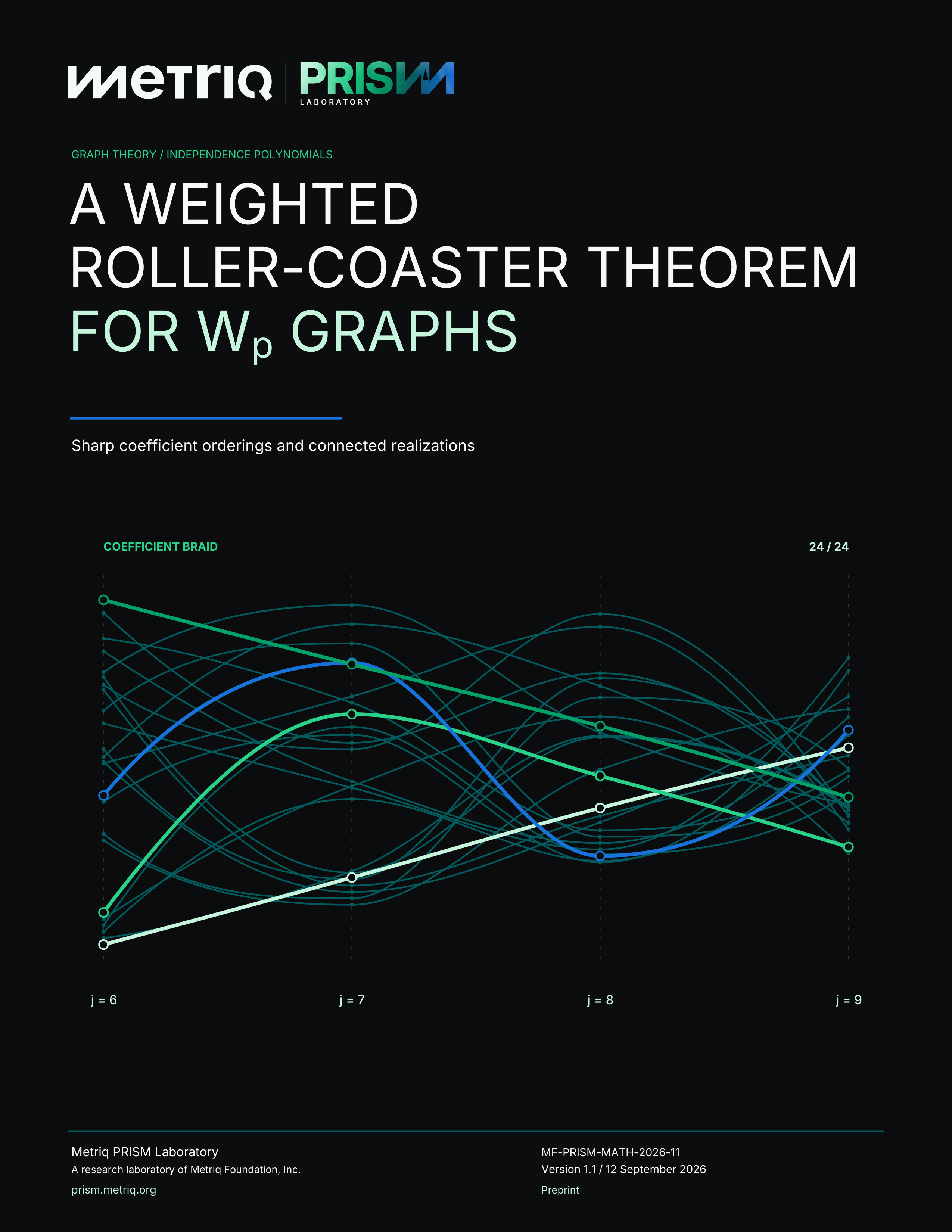
The paper proposes a sharp description of which coefficient orderings can occur in independence polynomials of connected W_p graphs and constructs graphs realizing every ordering in the permitted tail range.
An independence polynomial counts independent vertex sets by size. Its coefficients can rise and fall in many orders, and the Roller-Coaster problem asks which orderings are actually realizable by well-covered graphs.
The paper first describes a cone of coefficient vectors that W_p graphs must occupy. It then uses approximation and clique expansion to build connected examples whose tail coefficients appear in any prescribed strict order allowed by the theorem.
The paper’s technical details matter, but the basic route can be understood in three moves.
Derive the linear inequalities that constrain independence-polynomial coefficients for the W_p class.
Transfer a coefficient-approximation theorem through clique expansion to approach a desired ordering.
Construct connected W_p graphs and prove the cutoff where arbitrary strict tail orderings become attainable.
A closed coefficient cone is proposed for connected W_p graphs.
Every strict ordering in the stated sharp tail range is constructively realizable.
For p = 2, the result addresses the unrestricted-order 1-well-covered Roller-Coaster conjecture under the manuscript’s stated interpretation.
Candidate theorem for connected W_p graphs; the p = 2 case addresses the unrestricted-order 1-well-covered conjecture.
This manuscript presents a candidate resolution. Publication is not verification: independent specialist review remains necessary before the result should be treated as established.
The p = 2 consequence depends on the unrestricted-order interpretation of the original conjecture.
The transfer through the approximation theorem and clique expansion is a central review obligation.
Some certificates represent graphs too large to enumerate directly; the certificate logic must therefore be audited.
The theorem would sharply delimit the attainable coefficient orderings and settle the unrestricted-order 1-well-covered case under the stated interpretation.
These are the terms needed to understand the claim. The full paper uses them more precisely.
A set of vertices with no edge joining any pair in the set.
A polynomial whose coefficient of x^k counts independent sets of size k.
A graph in which all maximal independent sets have the same size.
A construction that replaces vertices by complete subgraphs to transform coefficient behavior.
The strongest review is not a general reaction. It tests the steps most capable of changing the conclusion.
This page is a reading guide, not a substitute for the manuscript. The public record links the explanation to the paper, source package, review materials, and persistent identifier.