Encode labelings algebraically
Use global and rooted Weyl-style alternants to represent signed assignments and edge-difference constraints.
THE IDEA, MADE VISIBLE
Change a labeling and test the graceful condition directly on a small tree.
A tree has no cycles. With n vertices, it has n−1 edges. A graceful labeling uses every vertex label from zero through n−1.
Differences: 5, 4, 3, 2, 1. This particular labeling passes.
Edge uv receives |label(u) − label(v)|
On a path, compare graceful and sequential labels. Sequential labels repeat difference 1 on every edge.
What this experiment represents. Exact finite labeling check. The tree drawings are teaching instances, not a rerun of the manuscript’s 7,812-type audit or a universal graceful-tree proof.
Global alternants, extremal-edge flows, and exact pruning tests
An exact signed-enumeration framework for graceful tree labelings, with global alternants, directed edge classes, and two leaf recurrences. The reconstructed finite audit reproduces 7,812 rooted types and the pruning results through thirteen vertices.
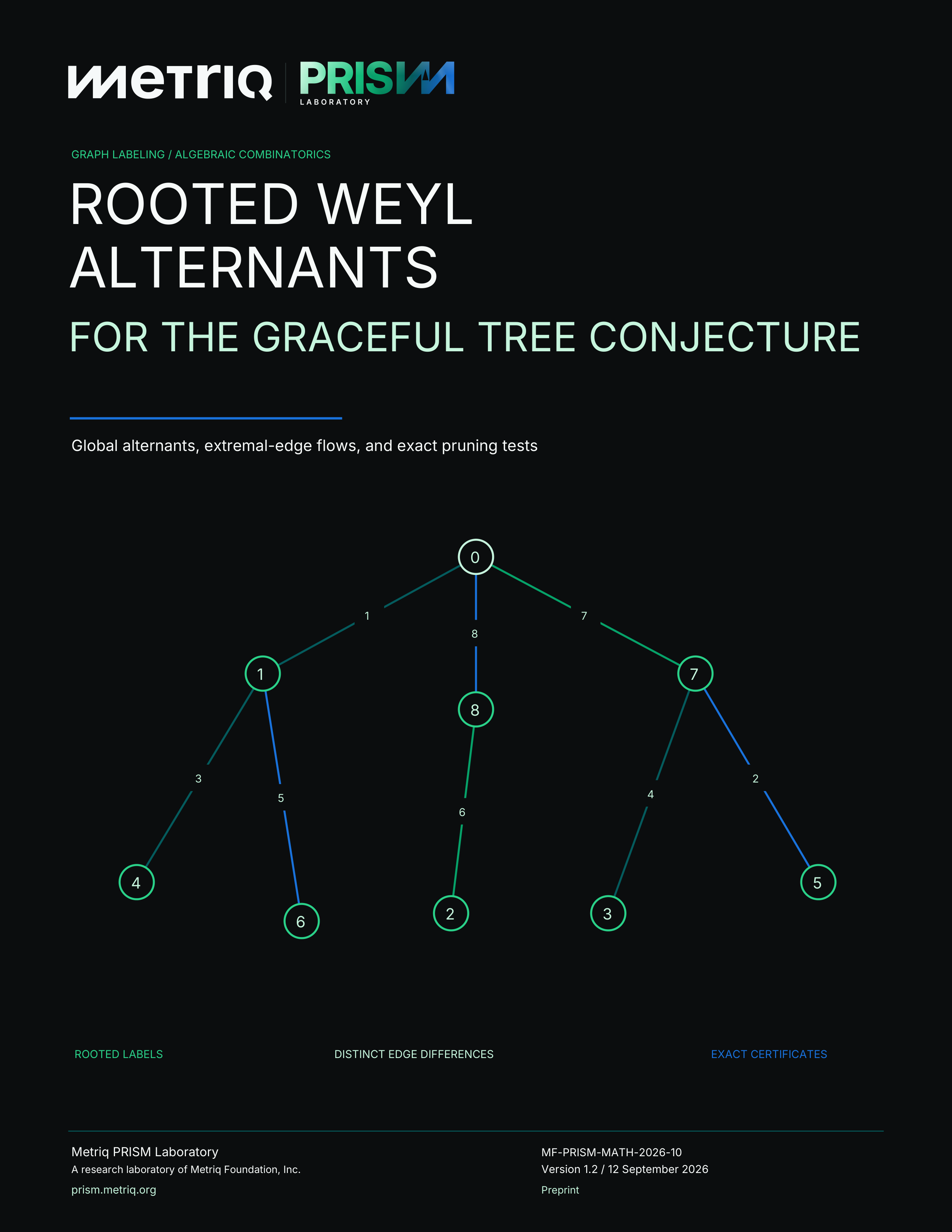
The paper turns graceful tree labeling into an exact signed-enumeration problem that can certify and prune finite cases, but it does not prove that every tree is graceful.
A graceful labeling assigns distinct numbers to the vertices of a tree so that the absolute differences across edges are also all distinct. The famous conjecture says every tree has such a labeling.
Instead of searching through labels one by one, the paper encodes candidate labelings in algebraic alternants. Coefficients can then act as exact witnesses: a nonzero coefficient signals surviving labelings, while leaf recurrences and symmetry reductions remove large blocks of redundant work.
The paper’s technical details matter, but the basic route can be understood in three moves.
Use global and rooted Weyl-style alternants to represent signed assignments and edge-difference constraints.
Direct edge classes, remove leaves recursively, and group symmetric sibling configurations when the coefficient identities permit it.
Reconstruct 7,812 rooted types and reproduce the published pruning results through thirteen vertices.
The manuscript supplies an exact algebraic framework for graceful-labeling searches.
Two leaf recurrences and symmetry reductions make finite certification substantially more compact.
The finite audit is partial progress only; universal nonvanishing for all trees remains open.
Method and partial progress; the universal Graceful Tree Conjecture is not resolved.
This manuscript develops a method and finite evidence, but it does not resolve the full open problem. The unresolved boundary is part of the published result.
No universal proof of the Graceful Tree Conjecture is claimed.
Finite nonvanishing certificates do not imply nonvanishing for every tree size.
The validity of every symmetry reduction must be checked coefficient by coefficient.
The framework turns parts of the graceful-labeling search into auditable algebraic certificates and exact finite pruning tests, while keeping the universal conjecture explicitly open.
These are the terms needed to understand the claim. The full paper uses them more precisely.
A vertex labeling whose edge differences are all distinct and use the required range.
A connected graph with no cycles.
A signed algebraic sum whose cancellations encode symmetry and distinctness.
A compact object that can be checked independently to verify a finite claim.
The strongest review is not a general reaction. It tests the steps most capable of changing the conclusion.
This page is a reading guide, not a substitute for the manuscript. The public record links the explanation to the paper, source package, review materials, and persistent identifier.