Reduce the grid matrix
Show an integral equivalence between the signed matching matrix and a structured Kronecker-sum operator.
THE IDEA, MADE VISIBLE
Test a common divisor across single-domino positions on small even squares.
The familiar even-square count has the form 2ᵐb² with b odd. For the displayed 2, 4 and 6 side lengths, b is 1, 3 and 29 respectively.
At this 6×6 position, both 1,276 and 5,452 are divisible by 29. Only one location is constrained.
T = 2ᵐb²; inspect T(required) mod b and T(forbidden) mod b
Use the 6×6 board and move the position slider. Both single-location counts remain divisible by 29.
What this experiment represents. Exact single-location counts for 2×2, 4×4 and 6×6 squares. Small-board remainder checks are not a proof of the universal divisibility assertion or its integral matrix argument.
Pachter’s divisibility assertion beyond the step diagonal
Identifies a common odd divisor retained when any one domino location is required or forbidden on an even square board. Integral matrix reduction separates odd denominators from the remaining factor of two.
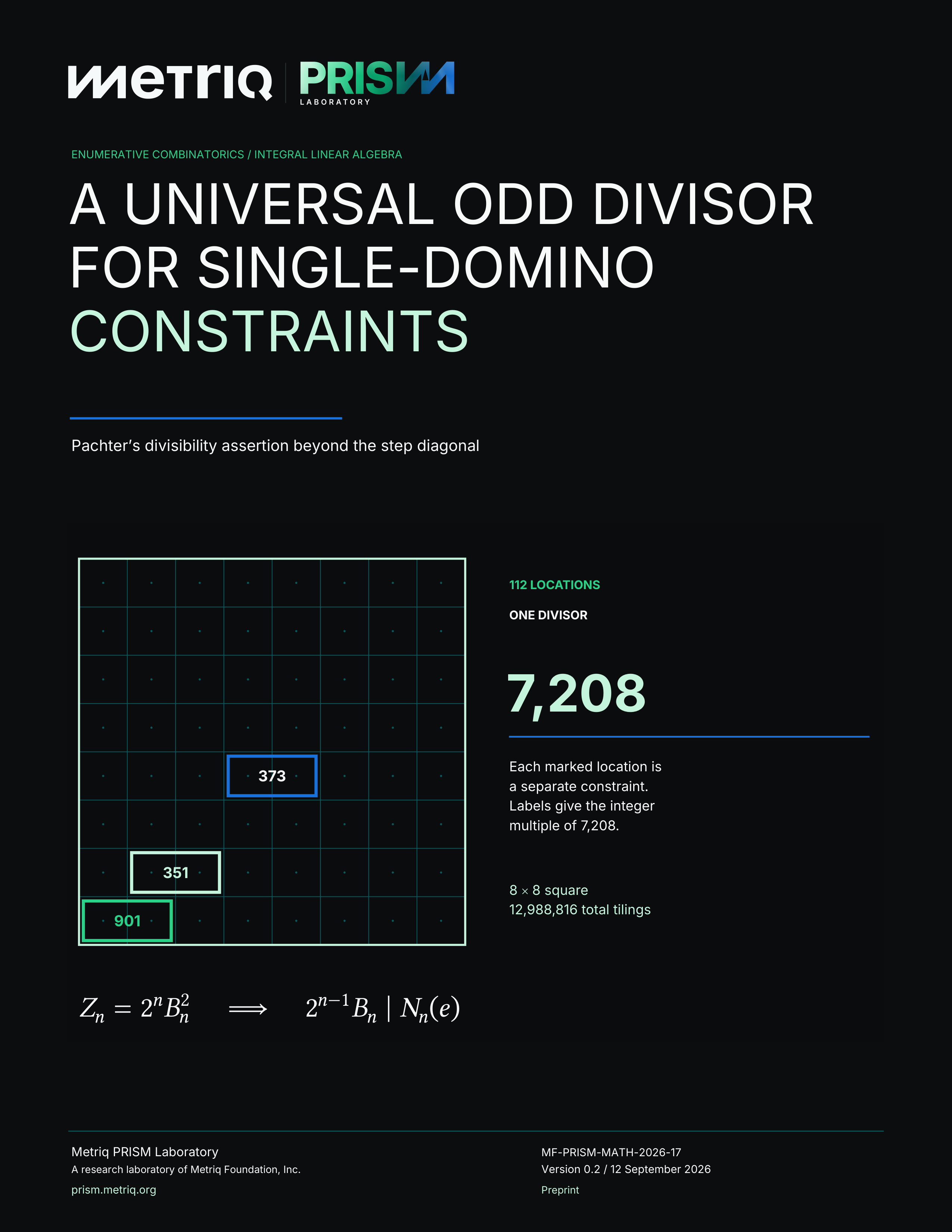
The paper proposes that every single domino position on an even square board shares one common odd divisibility factor, whether that domino is required or forbidden.
A constrained tiling count changes when one domino is forced or removed. The claim is that, despite the location-dependent count, the same odd number still divides every one of those single-location counts.
The argument converts the grid matching matrix into a Kronecker-sum operator, separates symmetric and alternating components in characteristic two, and controls the odd denominators that appear in inverse entries.
The paper’s technical details matter, but the basic route can be understood in three moves.
Show an integral equivalence between the signed matching matrix and a structured Kronecker-sum operator.
Use symmetric/alternating decomposition and cyclicity in characteristic two to isolate the odd divisor.
Relate inverse entries to the sign-correct counts for requiring or forbidding one domino location.
A universal odd divisor is proposed for every single domino position on an even square board.
The same divisor applies to both the required and forbidden version of a single constraint.
The theorem deliberately excludes simultaneous multiple constraints.
Candidate divisibility theorem for every single-domino position; simultaneous multiple constraints are outside the claim.
This manuscript presents a candidate resolution. Publication is not verification: independent specialist review remains necessary before the result should be treated as established.
Only one constrained domino position is covered at a time.
The result is stated for even square boards, not arbitrary regions.
Multiple simultaneous requirements or prohibitions may behave differently and are not claimed.
The theorem would extend the divisibility phenomenon from a special diagonal to every single location while sharply excluding simultaneous multi-constraint cases.
These are the terms needed to understand the claim. The full paper uses them more precisely.
A divisor with no factor of two.
A structured matrix sum built from smaller matrices using tensor products.
A transformation by invertible integer matrices that preserves key arithmetic data.
Parity arithmetic where adding an element to itself gives zero.
The strongest review is not a general reaction. It tests the steps most capable of changing the conclusion.
This page is a reading guide, not a substitute for the manuscript. The public record links the explanation to the paper, source package, review materials, and persistent identifier.