Choose a Schur family
Construct matrices tied to Schur functions for which the entry ideal can be calculated explicitly.
THE IDEA, MADE VISIBLE
Explore a small arithmetic obstruction before the manuscript’s Schur-matrix construction.
The ideal (p,x) consists of polynomial combinations of p and x. Among linear polynomials a+bx over the integers, membership requires p to divide a.
Over Z[x], a linear polynomial belongs to (p,x) exactly when 3 divides its constant coefficient.
a + bx ∈ (p,x) over Z[x] ⇔ p divides a
Keep p = 3 and switch the coefficient ring. Points excluded over the integers become reachable over the rationals.
What this experiment represents. Teaching analogue (p,x), not the manuscript’s Schur matrix or its full determinantal-ideal calculation. No stable-equivalence certificate is generated here.
An infinite family of arithmetic counterexamples
Constructs an infinite family of Schur-related matrices whose entry ideals are nonprincipal over the integral Laurent ring. The obstruction persists under identity stabilization and targets the general Schur-function clause of Kuperberg’s conjecture.
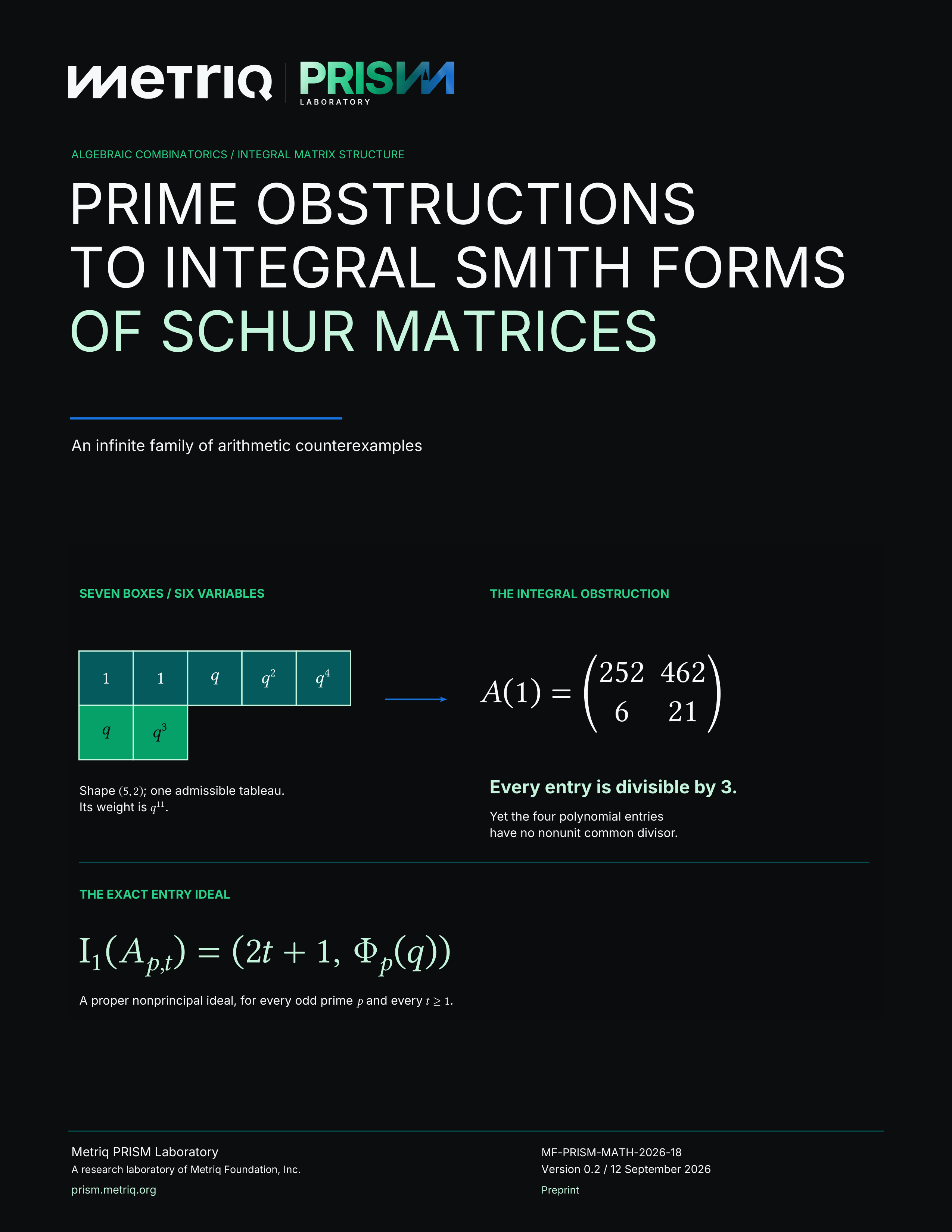
The paper constructs an infinite family in which the entry ideal is nonprincipal, blocking an integral Smith form even after identity stabilization and thereby targeting the broad Schur-function clause of Kuperberg’s conjecture.
A Smith normal form is a diagonal simplification of a matrix that exposes its arithmetic structure. Over integers and Laurent polynomials, such a form requires certain determinantal ideals to be generated by a single element.
The paper builds Schur-related matrices whose smallest relevant ideal needs two generators. Adding identity blocks does not repair that defect, so the obstruction survives the stabilization allowed by the conjectural statement.
The paper’s technical details matter, but the basic route can be understood in three moves.
Construct matrices tied to Schur functions for which the entry ideal can be calculated explicitly.
Work over the integral Laurent ring—not merely over rational coefficients—and show two generators cannot collapse to one.
Show identity stabilization leaves the obstructing determinantal ideal unchanged and transfer that fact to the conjecture’s stable-equivalence clause.
An infinite family of candidate counterexamples is given for the general Schur-function clause.
The obstruction is arithmetic: the relevant ideal is nonprincipal over the integral Laurent ring.
Identity stabilization does not remove the obstruction.
Candidate counterexamples to the general Schur-function clause of Kuperberg’s Conjecture 11; other clauses are not resolved.
This manuscript presents a candidate resolution. Publication is not verification: independent specialist review remains necessary before the result should be treated as established.
The paper targets the general Schur-function clause, not every part of Kuperberg’s Conjecture 11.
Special rectangular or otherwise restricted cases may remain unaffected.
The integral calculation is essential; a rational-coefficient simplification would not prove the stated obstruction.
The proposed infinite family would falsify the broad Schur-function clause while leaving unrelated rectangular or specialized clauses untouched.
These are the terms needed to understand the claim. The full paper uses them more precisely.
A diagonal matrix form that records divisibility invariants of a matrix.
A symmetric polynomial central to representation theory and algebraic combinatorics.
A polynomial ring that also allows negative powers of its variables.
An ideal generated by one element.
The strongest review is not a general reaction. It tests the steps most capable of changing the conclusion.
This page is a reading guide, not a substitute for the manuscript. The public record links the explanation to the paper, source package, review materials, and persistent identifier.