Define the heat-memory update
Specify a scalar recurrence that adds new thermal anomaly and partially retains prior stress.
THE IDEA, MADE VISIBLE
Rearrange an identical heat budget and see what a simple memory model retains.
Each synthetic 84-day record has exactly 42 days at HotSpot 1°C and 42 at zero, including the same final seven cool days. Terminal DHW is 6°C-weeks in every case.
All histories end with DHW = 6°C-weeks. The late history has model memory 11.619 at day 84; this is not a bleaching-risk estimate.
Dᵢ₊₁ = e⁻ʳ Dᵢ + Hᵢ(1−e⁻ʳ)/r, with one-day steps
Compare early and late with the same decay setting. Terminal DHW stays 6°C-weeks, while terminal model memory changes.
What this experiment represents. Synthetic 84-day histories and an explicitly chosen, unfitted scalar teaching model. The parameterization here is illustrative, not a reproduction of the paper’s fitted biology—there is no fitted biology or bleaching probability.
Order-sensitive heat memory, chronology bounds, and an auditable path to ReefWatch
Study how the order of heat exposure affects a precisely specified scalar memory model. The paper gives exact affine summaries and chronology bounds, with synthetic histories and a NOAA environmental-arithmetic audit.
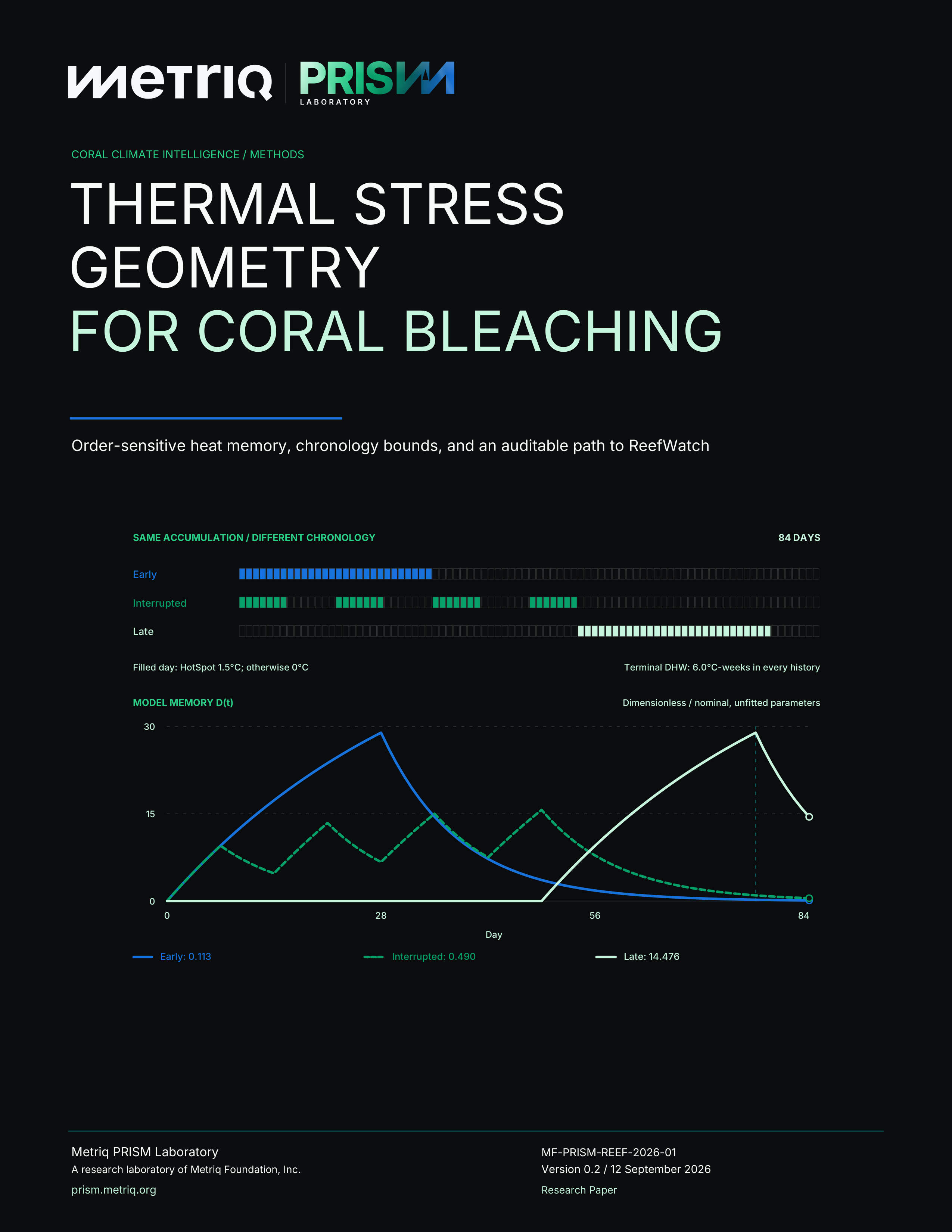
The paper shows how two reefs with the same total heat stress can receive different model states because the order and spacing of hot days are different.
Aggregate measures such as Degree Heating Weeks summarize accumulated heat, but they can erase chronology. A concentrated recent heat pulse and the same total spread over an older period may not represent the same biological stress history.
The paper studies a precisely defined memory recurrence that discounts older heat. Because the update is order-sensitive, it can distinguish histories with the same aggregate total and provide exact best- and worst-case chronology bounds.
The paper’s technical details matter, but the basic route can be understood in three moves.
Specify a scalar recurrence that adds new thermal anomaly and partially retains prior stress.
Derive an exact affine summary for a complete sequence of heat inputs.
Use chronology sorting to compute sharp upper and lower states when some timing information is uncertain.
Heat order can matter even when total accumulated heat is identical.
The scalar model admits exact affine summaries and chronology bounds.
A historical NOAA calculation audits environmental arithmetic, but no fitted bleaching probability is claimed.
Mathematical derivations, synthetic experiments, and a historical NOAA arithmetic audit. Model parameters remain illustrative and unfitted; no predictive skill for observed bleaching is established.
This report develops a conditional method and evaluates it within the stated evidence. It does not establish production performance, operational safety, or calibrated real-world predictive skill beyond that evidence.
Model parameters are illustrative and have not been fitted to observed bleaching outcomes.
The paper does not establish predictive skill or biological superiority over DHW.
Complete temperature support, masks, units, and provenance are required for a real validation.
Two reefs can accumulate the same headline heat metric through very different histories. An order-sensitive memory model may preserve biologically relevant chronology that aggregate totals erase.
These are the terms needed to understand the claim. The full paper uses them more precisely.
Temperature above a chosen expected or climatological baseline.
A cumulative heat-stress metric widely used in coral-reef monitoring.
A model whose current state retains part of earlier inputs.
An update that reduces the influence of older state over time.
The strongest review is not a general reaction. It tests the steps most capable of changing the conclusion.
This page is a reading guide, not a substitute for the manuscript. The public record links the explanation to the paper, source package, review materials, and persistent identifier.